.png)


Timepieces with Soul!

The new HENGE & SARSEN timepieces, with the whole dial cut from the same stone used to make the WORLD FAMOUS - STONEHENGE !

The stones that form the inner ring came from the Preseli Mountains in Wales, and are protected by the “Welsh National Park Authority”
Craig Rhos-y-felin is a rocky outcrop on the north side of the Preseli Mountains in Wales, which is designated as a RIGS (Regionally important geological and geomorphological site) site on the basis of its geological and geomorphological interest. It is accepted by many in the archaeological community that it is the site of a quarry, used together with one at Carn Goedog, for gathering stones used at Stonehenge.
The quarry is protected and only a very small amount the of the Preseli Bluestone is allowed to be used, and we are very fortunate to be one of only a small handful of small craft cottage industries to be allowed to use the stone for our STROND timepiece.
So then, it is fitting that we create a timepiece in order to tell the time as Stonehenge was used in part to tell the time for seasons and dates.
Here we see one of the carved rocks which lay buried for 1,000s of years.
Archaeologists are now certain that this is one of two sites used for making the inner circle at Stonehenge, and they did so by a kind of rock DNA chemical testing.
Name, Title

Interestingly a huge stone unearthed at this site is thought to have been one of the stones prepared for Stonehenge, but if you look carefully at the above photo, you will notice a crack going across the stone. Archeologists think that in preparing this stone some 4,000 years ago, it cracked and so was abandoned !
And for the SARSEN stone, Geochemical fingerprinting helps discover where the Stonehenge Sarsen stones originated.

Professor David Nash is an expert in geochemical sediments and environmental change. He was joined by his Brighton colleagues Dr Jake Ciborowski and Dr Georgios Maniatis and partners that included archaeologists and Stonehenge experts Professor Timothy Darvill.
Elements of the stone circle traced to West Woods on the edge of the Marlborough DownsFrom their pXRF data, Professor David Nash's team discovered that 50 of the 52 sarsen stones at Stonehenge share a consistent chemistry, pointing strongly to a common quarry source,the most likely source of the sarsen stones as West Woods, on the edge of the Marlborough Downs, north of Stonehenge, around 15 miles north of the famous stone circle.
Dr Jake Ciborowski undertaking pXRF analyses at Stonehenge
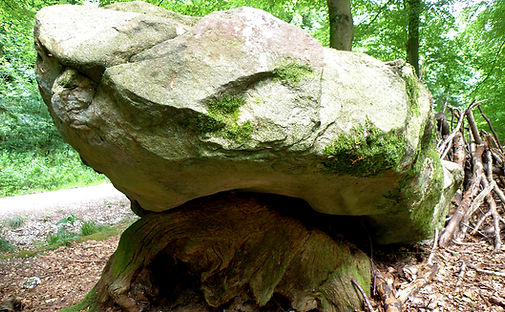
A SARSEN boulder at West Woods, around 20 milles from Stonehenge
VIDEO Professor David Nash of Brighton University explains the origins of the SARSEN stone
The STROND Henge & Sarsen timepieces.
So for watch enthusiasts & iconic landmark lovers we are giving people the opportunity to wear a piece of history. Limited to only 300 pieces. Each watch has a unique serial number engraved onto the back of the watch case, for example serial number 005/300


The bezel and crown top are engraved with the Celtic knot, giving a very authentic feel to the timepiece !